Work that
made a difference.
Music Festival
For more than 50 years, the Santa Fe Chamber Music Festival has brought world-class musicians to New Mexico, presenting one of the country's longest summer chamber music seasons and commissioning 100+ new works since 1980. The artistic ambition was never in question.
What needed attention was the communications system behind it. Over decades, inconsistent brand expressions accumulated: multiple logo versions, style guides that existed but were not consistently applied, and contributors working without a shared plan or unified direction. There was considerable effort, but no durable framework. This is a common gap in cultural institutions, and it is exactly the kind of situation Santa Fe Marketing is designed to step into.
Built the Festival's marketing infrastructure across the full season cycle, from pre-season planning through the final performance. Unified the visual identity across the Festival Program Book, brochures, flyers, and newsletter templates. Ran coordinated regional and digital campaigns and extended the effective marketing budget through negotiated in-kind support. Created a clear production calendar and approval workflow so staff and vendors could execute without chaos, and maintained creative oversight across all public-facing materials throughout the season.
Presented the Festival's first integrated marketing ROI report to the board, documenting negotiated in-kind value, earned media value, and partner contributions. Ticket sales increased over the prior season, and consistency improved measurably across print, digital, and earned media. The organization closed the season with a repeatable system, a working calendar, and the internal language to evaluate return year over year.
“The most valuable thing wasn’t any single campaign. It was giving the board language to understand what strategic marketing investment actually returns, so the conversation could move from ‘can we afford another newspaper ad’ to ‘what did last season’s campaign actually return.’”
Santa Fe
SITE Santa Fe helped pioneer the U.S. model of the international contemporary art biennial. But in the mid-2000s, it lacked the web infrastructure needed to document each cycle and share the work beyond Santa Fe, limiting reach and long-term public record.
Led the creation of dedicated microsites for four consecutive SITE Biennials, collaborating directly with curators Robert Storr (2004), Klaus Ottmann (2006), Lance Fung (2008), and Sarah King and Daniel Belasco (2010). These microsites became a primary window for international audiences into programs that were otherwise experienced only on-site, extending each biennial’s reach and creating a durable public record aligned with its international mandate.
Built a digital infrastructure that had not previously existed for the institution, from the inside, across four consecutive cycles. Held multiple roles simultaneously, including preparator, audiovisual technician, and web developer, developing an inside-out understanding of how museum operations, production, and communications intersect in real time.
A sustained, coherent digital presence across four biennial cycles, built in direct collaboration with internationally recognized curators. The work produced long-term institutional fluency rooted in real operations, not assumptions.
“Working inside SITE across four biennial cycles taught me how museums really function. That gap between public messaging and day-to-day reality is exactly where strong communications leadership has to operate.”
NEXT100
The 100th anniversary of the Bauhaus in 2019 generated cultural programming across Germany and around the world. Most of it looked backward. NEXT100 was founded on a different premise: that the centenary was an opportunity to look forward, toward the next hundred years of Bauhaus influence on art, technology, and design.
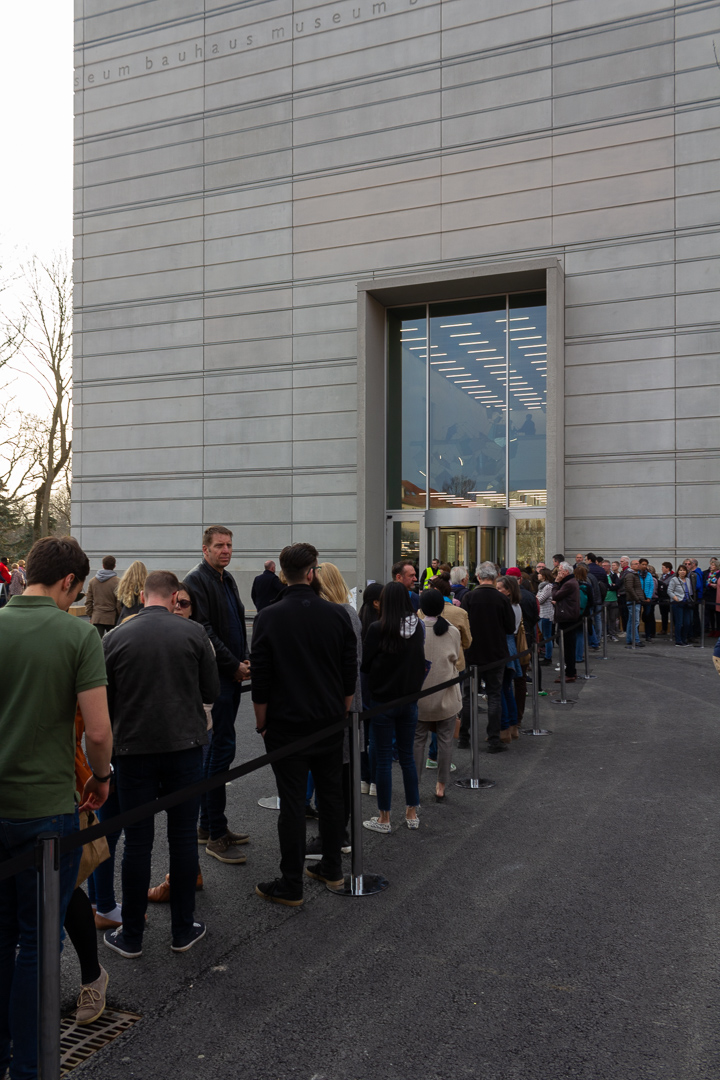
That forward-looking program thesis was distinct enough to attract the attention of the dean of Bauhaus University, local government, institutional partners, and the artistic community in Weimar. The organization was ultimately invited to anchor the official opening day and evening programming for the new Bauhaus Museum.
Co-founded and legally established a German nonprofit arts organization from scratch. Built the team, governance structure, board, institutional partnerships, and funding relationships needed to operate credibly in an international context. Secured formal partnerships with Bauhaus University and the City of Weimar, along with programming partners across multiple countries. Produced a year-long public program spanning performances, talks, and partner-led events, culminating in the official opening day and evening program at the new Bauhaus Museum on April 6, 2019. To make that possible, built a working system for production and communications capable of holding up under a fixed and very public deadline. Coordinated musical performances, curatorial programming, and public communications across multiple countries throughout the year.
The work resulted in a high-visibility opening day and evening program and a sustained public program delivered on immovable dates, under institutional and public scrutiny, in a foreign country and a second language. What remained was a durable institutional structure built from nothing, with the governance and partnerships to withstand public scrutiny.
“Building an organization from scratch, in a foreign country, under international scrutiny, taught me something I carry into every client relationship: the work is never just the event or the campaign. It is the system you build to make the event or campaign possible, and whether that system holds up when the pressure is real.”